
Why energy is your hotel’s first savings project
A hotel consumes around the clock: heating and cooling, domestic hot water, lighting of common areas, rooms often heated or cooled while empty. Unlike other costs, every euro of energy saved goes straight to the margin — there is no variable cost to recreate behind it.
Two pressures now add up: the lasting rise in the price of energy, which weighs on the operating account, and regulation that imposes reduction targets. The good news: both are addressed with the same levers.
Where the energy goes in a hotel
Before acting, you need to know where the energy is spent. In a hotel, consumption generally breaks down as follows:
- Heating / cooling
- 46 %
- Domestic hot water
- 17 %
- Lighting
- 12 %
- Plugs & other
- 25 %
Heating and cooling dominate by far (close to half), followed by domestic hot water and diffuse uses (plugs, kitchen, laundry). So it is on HVAC that most of the savings are made.
And the real potential is not gross consumption, it is waste: fixed settings, empty rooms heated to 22 °C, a cooling unit running with the window open. That is exactly what smart control eliminates.
The most profitable lever: control rather than endure
Even before renovating, the most profitable move is to finely control what you already have. An energy management system (the technical building block is called a BMS, building management system) automatically adjusts heating, cooling and lighting according to real occupancy, schedules and conditions.
- Temperature set-points matched to the real occupancy of each room.
- Open-window detection → automatic cut-off of heating/cooling.
- Scheduling by zone, by day, by season.
- Centralised supervision of the whole establishment from a single interface.
- Alerts on any drift in consumption, before the bill spikes.
This is the heart of our approach: see HumeSmartEnergy, our BMS for energy control & savings.
The connected room: guest comfort AND savings
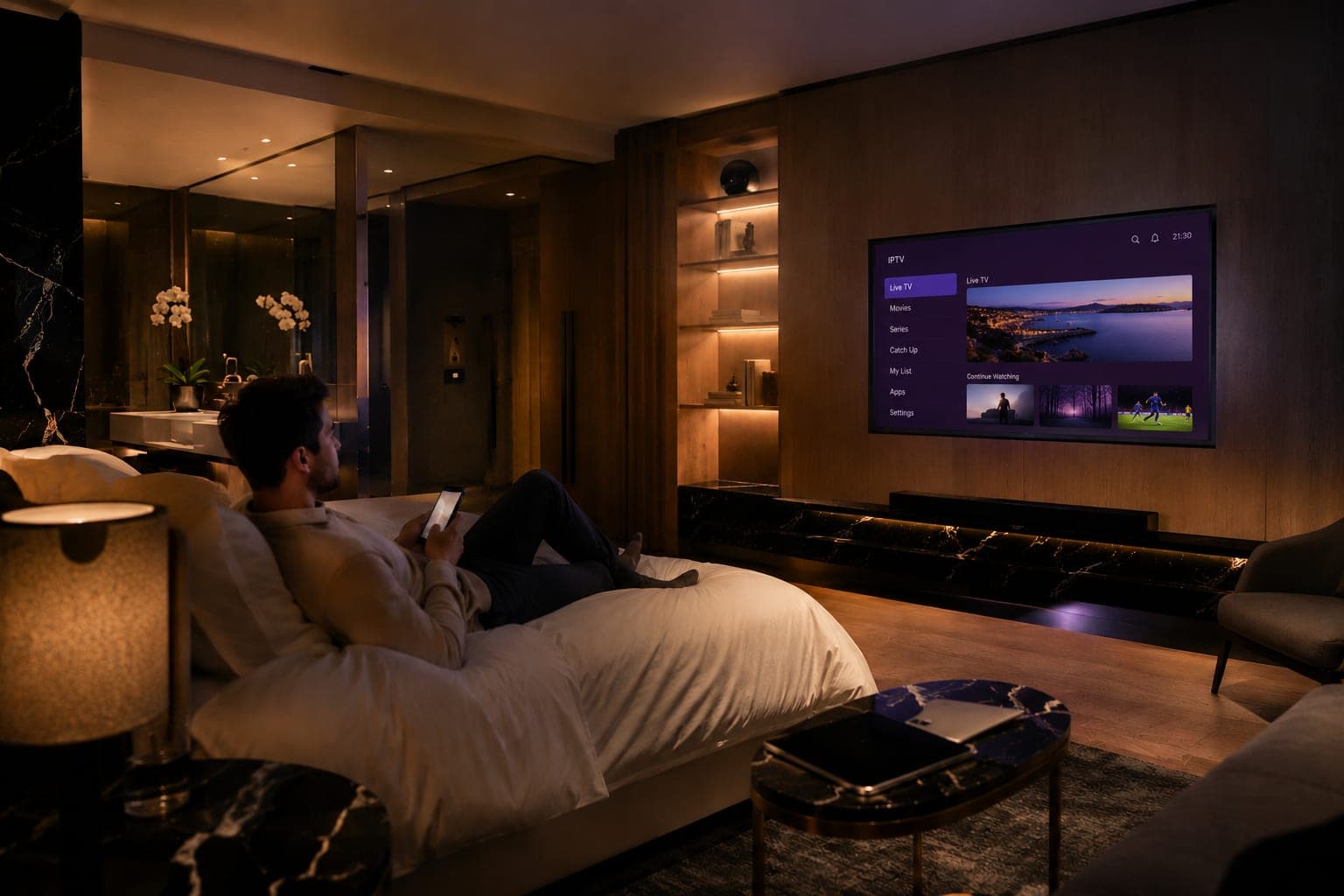
The connected room reconciles two goals often thought to be opposed. When the guest leaves the establishment or steps out, the room automatically switches to eco mode; on their return, comfort is restored before they open the door. The guest gains control (clear thermostat, ambience scenarios), the hotel saves on every room-night.
Savings are not paid for in comfort. Good control is invisible to the guest — they only notice the room is always at the right temperature.
Regulations: turn the constraint into savings
Energy regulations increasingly require tertiary buildings to reduce their consumption and, above certain HVAC power thresholds, to install a building automation and control system (a BMS). Rather than a last-minute compliance exercise, make it a savings lever from the first heating season. We can help you qualify your obligations.
Where to start: audit, quick wins, control
- Measure. An energy audit identifies the real consumption points and quantifies the savings potential specific to your building.
- Quick wins. Set-point tuning, switch to LED, time scheduling: immediate gains at low cost.
- Control. Deploy a BMS / centralised control to capture the bulk of the potential (HVAC + rooms).
- Monitor. Continuous supervision and drift alerts so the savings last over time.
We support every step, from audit to multi-site deployment, in hotels as well as healthcare establishments and holiday residences.
Frequently asked questions
How much can you save on a hotel’s energy bill?
Savings depend on the building, its age and its equipment. They are quantified by an energy audit that compares your current consumption to the potential after control — generally a reduction of 20 to 40% depending on the building and equipment. Most of the potential is usually on HVAC and unoccupied rooms.
What is a BMS?
A BMS (building management system) is the system that automatically supervises and controls a building’s technical equipment — heating, cooling, ventilation, lighting — to optimise comfort and consumption from a centralised interface.
Do you have to renovate the whole building to save energy?
No. The most profitable lever is first to better control what already exists (set-points, occupancy, scheduling). Heavy renovation comes later, once the “control” potential has been captured.
Quantify your energy savings
An energy diagnostic identifies your waste and the savings potential specific to your establishment.
Request an energy diagnostic